
Anti-human KIR2DL1 antibody
Clone: KIR2DL1.03
Catalog No.: HR-Lympho-05
Host Species: Mouse
Reactivity: Human
Antigen/Immunogen: The immunogen consisted of KIR2DL1 ectodomain fused to the hIgG1 Fc fragment and was produced from the supernatant of HEK 293T cells
Tested Applications: ELISA, FACS
€200.00 – €1,500.00
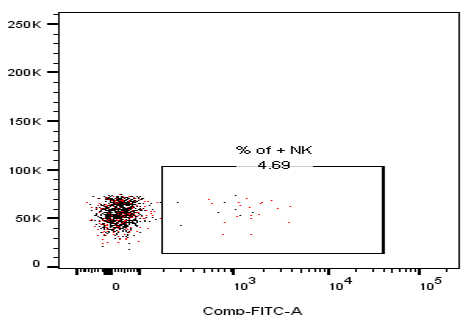
Anti-human KIR2DL1 antibody
Dot plot graph showing CD56+ hPBMCs stained with 1:100 KIR2DL1.03 Ab (red dots) and FITC conjugated anti-mouse IgG . Isotype control antibody (black dots) was mouse IgG used under the same conditions.
Available Options:
Description
Killer cell immunoglobulin-like receptors (KIRs) are transmembrane glycoproteins expressed by <1-8% NK cells and subsets of CD8+ T cells (Melero et al., 1994, The Journal of Immunology, 152(4)). KIR2DL1 or CD158a, is a 58-kDa type I transmembrane protein encoded by KIR2DL1 gene and contains two extracellular Ig-like C2-type domains (2D) and a long cytoplasmic tail (L) which transduces inhibitory signals via an immune tyrosine-based inhibitory motif (ITIM) (Konjevic et al., 2012, Immunologic Research, 52, 139–156). KIR proteins are capable to recognize MHC class I molecules on target cells and inhibit cytotoxicity and are thought to play an important role in the regulation of immune response. KIR2DL1 binds ARRB2, PTPN6, PTPN11, HLA-B and C2-group of HLA-C molecules (Van Der Ploeg et al., 2017, Front. Immunol, 8, 298.). Our anti-KIR2DL1 antibody KIR2DL1.03 works in ELISA (on immunogen) and in FACS (on human cells).
Additional information
| FORM | Liquid |
|---|---|
| STORAGE | Long term -20 °C, short term +4 °C. Avoid freeze-thaw cycles. |
| CONCENTRATION | 1 mg/mL |
| PURITY | Affinity purified |
| CLONALITY | Monoclonal |
| ISOTYPE | IgG1 |
| LIGHT CHAIN TYPE | kappa |
| REFERENCES | n/a |
Documents
Related products
Antibodies

Antibodies
Antibodies
Antibodies
Antibodies